
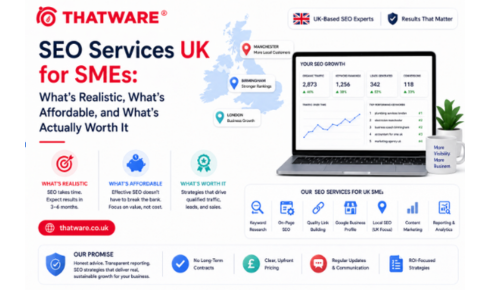
Small and medium-sized businesses in the UK face a particular frustration with SEO. The discipline is clearly important — they can see their competitors ranking for terms they should be ranking for, and they know that organic search drives real commercial outcomes. But the information landscape around what SEO actually costs, what it realistically delivers, and which agencies are worth trusting is genuinely confusing.
Prices vary by an order of magnitude across the agency market. Promises of first-page rankings proliferate. The definition of “affordable SEO” ranges from a few hundred pounds a month to a few thousand. And the difference between what’s worth paying for and what’s a waste of money isn’t always obvious from the outside.
This is an attempt to give UK SMEs a honest picture.
What SEO Actually Costs in the UK Market
Let’s start with the price question because it’s the one everyone wants answered and the one most agencies dance around.
The UK SEO market broadly breaks into three tiers, and understanding what each tier actually delivers is important.
The low tier — typically £200–£600 per month — exists primarily in the form of productised SEO packages. These usually include a limited number of keywords tracked, some automated reporting, occasional backlink activity, and perhaps a content piece or two per month. At this price point, the economics of agency work mean that the attention you’re receiving is minimal — possibly a few hours per month. This tier occasionally produces results for very local businesses with minimal competition, but for any business in a remotely competitive market, it’s largely money spent maintaining the illusion of doing SEO.
The mid tier — roughly £800–£2,500 per month — is where meaningful SME SEO work happens. At this level, you’re accessing actual strategic and implementation capacity: technical auditing, proper keyword research and content strategy, genuine link building, and enough reporting bandwidth to understand what’s happening and why. Results are possible and, for businesses in the right circumstances, significant.
The upper-mid and premium tier — £3,000+ per month — is where more complex or competitive situations are addressed, where you have access to senior practitioners, and where the scope of work expands to cover more ground simultaneously.
The honest reality for most UK SMEs is that meaningful SEO investment sits between £800 and £2,500 per month, and that the budget should be sustained for at least twelve months before expecting the compound effects to fully manifest.
What’s Realistic for Different Business Types
Not every UK SME has the same SEO opportunity, and setting realistic expectations depends on understanding where you sit.
Local service businesses — plumbers, solicitors, estate agents, dental practices, physiotherapy clinics — have a local SEO opportunity that’s genuinely achievable with appropriate investment. The competition is local rather than national, the relevant search volumes are concentrated around specific local intent queries, and the commercial value per conversion (a new client, a new patient, a property vendor) is typically high. Proper Google Business Profile optimisation, local citation management, localised website content, and selective link building can produce meaningful results within six to twelve months for most local businesses.
B2B service businesses selling nationally face a different challenge. The keyword environment is more competitive, the buyer journey involves more research, and the timeline to meaningful organic traffic is typically longer. The opportunity is still real — particularly through thought leadership content that captures demand at the research stage — but expectations around the timeline need to be managed.
E-commerce businesses competing nationally need to think carefully about where their realistic opportunity sits. Competing with ASOS, Boots, or Amazon for broad category terms is not a realistic objective for an SME. Finding the specific niches, long-tail queries, and underserved subcategories where organic competition is thinner — and building genuine authority there — is the realistic strategy.
The Questions That Reveal Agency Quality
When you’re evaluating seo services uk providers as an SME, the questions that cut through the noise are worth knowing.
Ask them to explain their process for your specific situation. Not their process in general — specifically, for a business like yours, with your competitive context, what would they do in the first three months and why? Agencies that can answer this specifically are thinking about your situation. Agencies that respond with generic frameworks are applying templates.
Ask who will actually work on your account. In many UK agencies, the person who pitches you is not the person who does the work. Understanding the seniority and experience of the team that will actually deliver matters significantly.
Ask for examples of clients in a similar situation — not the biggest wins they’ve ever had, but clients at a similar size and competitive level to you. What results did they achieve? How long did it take? Are those clients still with the agency? Client retention is one of the cleanest signals of genuine value delivery.
Ask what happens if Google updates its algorithm and your rankings drop. The answer should involve a specific process for diagnosis, adjustment, and communication — not vague reassurances.
The Things Most Worth Investing In
For UK SMEs with constrained budgets, not everything can be done simultaneously. Understanding which activities have the highest return on SEO investment helps prioritise.
Technical foundations matter disproportionately early in an SEO programme. If your site has indexation issues, crawlability problems, or significant page speed issues on mobile, no amount of content or link acquisition will overcome them. Getting the technical foundation right first is correct prioritisation.
Google Business Profile optimisation is one of the highest-ROI activities for local businesses and is chronically underinvested. A properly optimised, actively managed GBP — with complete category selection, regular posts, systematic review management, and accurate information — consistently drives local search visibility at relatively low cost.
Content that targets realistic keyword opportunities — not the highest-volume terms but the ones where genuine ranking is achievable given your current authority — builds compounding traffic over time in a way that other activities don’t.
Link building from genuinely relevant sources — local business associations, regional press, industry publications, genuinely relevant websites — builds the kind of authority that holds up under algorithm changes in a way that manufactured links don’t.
The Affordability Reality
Here’s the honest answer to “what’s affordable” that most agencies won’t give you directly.
If you genuinely can’t sustain £800–£1,000 per month for at least twelve months, you’re probably not yet at a stage where a full-service SEO agency is the right investment. The economics of agency work mean that below this threshold, you’re not getting enough attention to produce meaningful results in competitive markets.
The alternatives worth considering if budget is genuinely constrained:
An SEO audit from a reputable consultant (a one-time investment, typically £1,500–£4,000) followed by in-house implementation is sometimes more cost-effective than a low-budget agency retainer. You get genuine expertise in the diagnosis phase, and then implement at your own pace using your own resources.
A focus on the single highest-leverage activity for your specific situation — often Google Business Profile for local businesses — rather than a broad but underfunded approach across all SEO activities.
A longer runway to save to the threshold where meaningful agency work is possible, rather than spending budget on activity that’s unlikely to produce results.
The businesses that waste the most money on SEO are often the ones who engaged multiple low-cost agencies over several years, each of which produced little, rather than one sustained engagement at a level where the work could actually move the needle.
What “Worth It” Actually Looks Like
Seo company UK relationships that are genuinely worth the investment share certain characteristics over time.
They produce traffic that converts, not just traffic. The measure of SEO success for an SME isn’t ranking or session counts — it’s leads, enquiries, footfall, or sales from organic sources.
They communicate honestly, including about things that aren’t working. The most valuable agency conversations are often the ones where the agency says “this approach isn’t working as expected and here’s what we want to try instead” — not the monthly reports that show green arrows regardless of actual commercial impact.
They adjust strategy based on what the data shows. The SEO strategy that made sense in month one should evolve as you accumulate information about what’s working, what competitive opportunities are opening up, and how your market is changing.
And they treat your budget as if it were their own — thinking about return on every pound spent rather than maximising scope to fill a retainer.
That combination is rarer than it should be. When you find it, the results over a sustained period are genuinely significant, and they compound in ways that make organic search one of the most valuable growth investments an SME can make.