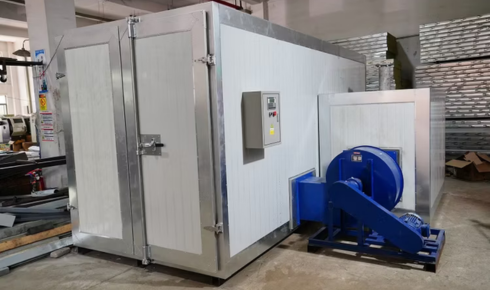
Consistent finish quality depends on how well heat moves through a coating oven. In propane powder coating ovens, precise heat distribution determines whether parts cure evenly or end up with inconsistencies. Understanding how airflow, burner control, and thermal management work together helps explain why advanced powder coating equipment achieves professional-level results.
Strategic Fan Placement Fostering Uniform Chamber Airflow
Fans control how hot air circulates through the oven, and their placement determines whether all surfaces receive equal exposure. Strategically positioned fans create balanced airflow that prevents heat buildup in one section and cold spots in another. In large propane powder coating ovens, these fans work in pairs or clusters to guide air evenly across the chamber.
Balanced airflow improves coating adhesion by ensuring consistent curing temperatures throughout the load. Without proper fan design, parts positioned near the walls or corners may heat unevenly, leading to variations in finish thickness or gloss. Manufacturers often fine-tune fan angles and speeds to maintain a smooth, rolling air current that touches every surface.
Zone-specific Burner Modulation Maintaining Consistent Surface Temperatures
Modern ovens divide their interior into heating zones controlled independently by burners. Each zone’s modulation allows fine temperature adjustments that prevent overheating delicate materials or under-curing thicker parts. This flexibility lets operators handle mixed loads without risking performance differences.
Zone modulation also saves energy. By only activating burners where needed, the system uses propane efficiently and keeps chamber temperatures stable. The result is smoother performance across long production runs—a key benefit for facilities using advanced powder coating equipment on various metal parts.
Multi-port Air Distribution Preventing Stagnation and Hot Pockets
Multi-port air systems channel heated air from several entry points rather than a single duct. This design prevents stagnant airflow that can trap heat in one area or leave sections underexposed. Each port contributes to a balanced circulation pattern, ensuring every corner of the oven maintains uniform temperature. Hot pockets are one of the most common causes of coating defects. With multi-port systems, air blends dynamically throughout the chamber, allowing heat to reach recessed or densely packed surfaces. The continuous movement guarantees even color curing and smooth finishes across complex shapes.
Insulation Layering Reducing Thermal Decay Through External Surfaces
The outer shell of a propane powder coating oven stays cool thanks to multi-layer insulation. Each layer, often a combination of fiberglass and ceramic fiber, traps heat inside the chamber while minimizing external energy loss. This helps maintain stable internal conditions and prevents heat bleed into the work environment. High-grade insulation also protects internal components from heat fatigue. By holding temperatures steady, it reduces burner cycling and extends the life of sensors, wiring, and fans. This level of energy containment is part of what makes quality ovens so reliable and cost-efficient in long-term operation.
Heat-exchanger Tubing Oriented for Optimized Combustion-to-air Transfer
Inside every propane powder coating oven lies a network of heat-exchanger tubes that convert combustion energy into usable chamber heat. The orientation and curvature of these tubes dictate how efficiently heat transfers from the flame to the circulating air. Properly aligned exchangers create smooth heat gradients, preventing temperature spikes.
Inefficient tube layouts can waste fuel and slow heat recovery times. By optimizing their shape and position, engineers ensure faster warm-up cycles and improved uniformity across the curing chamber. This design precision allows operators to reach and maintain set temperatures quickly, improving production throughput.
Vertical and Horizontal Convection Paths Ensuring Thorough Coverage
Convection paths—both vertical and horizontal—guide how heated air moves around parts inside the oven. Vertical convection lifts heat upward, while horizontal flow distributes it across shelves and hangers. The combination ensures that parts at different elevations or positions cure at the same rate.
This multi-directional convection approach benefits large or oddly shaped items that need consistent exposure from all sides. It prevents uneven color tone or incomplete curing near base sections and inner cavities. For users of advanced powder coating equipment, this system provides repeatable quality with minimal manual intervention.
Precision Baffle Design Directing Airflow Across Large or Complex Loads
Baffles are interior panels that steer airflow to avoid direct blasts of heat on sensitive surfaces. Their placement shapes how air circulates, guiding it evenly around parts suspended or stacked inside the oven. A well-designed baffle system prevents both overheating and under-curing by diffusing airflow evenly.
For complex assemblies or irregular loads, precision baffles help maintain temperature balance throughout the batch. They turn chaotic airflow into smooth circulation that wraps uniformly around each component. This structural feature plays a major role in achieving uniform coatings and dependable finish consistency.
Real-time Thermal Mapping Verifying ± 3 °C Uniformity Zones
Advanced propane powder coating ovens rely on thermal mapping systems that monitor heat distribution in real time. Sensors placed at multiple chamber points record temperature variations, allowing adjustments to maintain a uniform ±3 °C range. This continuous monitoring ensures all areas stay within the curing specifications.
Thermal mapping data also supports quality verification. By documenting consistency, operators can confirm compliance with coating standards and detect potential airflow or burner imbalances before they cause issues. This technology-driven feedback loop gives manufacturers confidence that each batch meets the same precise quality standard.
Reliant Finishing Systems produces propane powder coating ovens engineered with these heat distribution features in mind. Their designs integrate controlled airflow, smart burner modulation, and advanced thermal monitoring to help manufacturers achieve uniform finishes, energy efficiency, and consistent results across every production cycle.